
Waste is the residual output of various production processes, occurring in both industrial and domestic (household) activities. The presence of this waste is often undesirable for the environment, especially if it lacks economic value and only burdens the ecosystem. Improperly managed waste can become a source of pollution, particularly in water, which can disrupt the natural balance and environmental quality.
In the context of fisheries production, water pollution is a serious issue. This pollution occurs when living organisms, energy substances, or other materials enter or are absorbed into water bodies through human activities or natural processes. The entry of these various substances causes changes in the composition and quality of the water, thus reducing its ability to support aquatic life and fishery activities. This pollution can lead to a decline in water quality to a certain level where the water can no longer function according to the needs of fisheries production.
One of the main sources of waste in fisheries production is from the cultivation and processing of fish products. On a global scale, waste generated from fishery activities can reach 20-30 percent of total production, with an estimate that out of 6.5 million tons of fish production per year, about two million tons are wasted. This figure shows the high potential for pollution that can occur if the waste is not managed properly.
In Indonesia, one type of fish that is very popular and widely cultivated and processed by the community is tilapia. The waste generated from the cultivation and processing of tilapia, both in the form of fish scraps and other waste, has great potential to be utilized into products that have economic value. Along with the development of technology and awareness of the importance of waste management, in recent years there have been many innovations that lead to the utilization of tilapia waste into various products that have added value.
This article will delve deeper into the various ways to utilize tilapia waste, from processing bone, skin, and offal waste into useful products with high economic value.
1. Hydroxyapatite from tilapia bone waste
The hydroxyapatite product produced from tilapia bone waste is one of the important innovations in the utilization of fishery waste. Hydroxyapatite is a crystalline calcium phosphate compound containing hydroxyl ions and is the main mineral contained in bones, reaching about 43 percent of the total bone weight. The presence of this compound not only shows the potential of fish bone waste as a valuable raw material but also highlights the importance of waste management into something that has economic value and environmental benefits.

Workers display fish bone waste after the drying process: ANTARA FOTO/Syifa Yulinnas/wsj
Tilapia fish bones are chosen as the base material for hydroxyapatite production due to their chemical composition rich in inorganic substances, especially calcium phosphate and hydroxyapatite itself. In addition, fish bones also contain collagen, which is an important structural protein that provides strength and flexibility to bones. The inorganic content in fish bones ranges from 60-70 percent, making them an ideal material to be processed into hydroxyapatite. This process involves heating the bones at high temperatures, around 600°C to 900°C, to form a microporous structure that is a characteristic of hydroxyapatite.
This high-temperature heating process not only aims to change the chemical structure of fish bones into hydroxyapatite but also to create physical properties that allow this compound to effectively absorb heavy metals. The microporous structure formed in hydroxyapatite from fish bones has a large capacity to absorb contaminants such as heavy metals found in solid waste, liquid waste, and fly ash. This ability makes hydroxyapatite a very useful material in various industries that are vulnerable to heavy metal pollution.
The use of hydroxyapatite from tilapia bone waste has shown its effectiveness in reducing heavy metal pollution in various industrial sectors. For example, the textile industry, leather tanning, metal plating, and batik industry all use materials that can produce toxic waste containing heavy metals. With hydroxyapatite, this toxic waste can be absorbed and treated more safely, thus reducing the negative impact on the environment.
2. Leather jackets from tilapia skin waste

Tanned tilapia skin: World Spy
The utilization of tilapia skin waste from the fillet industry into leather jacket products is an innovation that not only offers a solution to the waste problem but also creates products with high economic value. Tilapia skin, which was initially considered waste, can be transformed into high-quality raw material for making clothes, especially jackets, through the right process. In the fashion industry, jacket leather must meet various strict quality standards, including strength, durability, and comfort. Research shows that the leather produced from tilapia waste has physical and mechanical properties that resemble conventional leather, thus being able to meet the requirements set in SNI 06-4593-1998, which regulates the standards for jacket leather from sheepskin.
The process of making leather jackets from tilapia skin waste involves several important stages, one of which is washable leather tanning. At this stage, tilapia skin is processed using a 10 percent concentration of reactive dye, 10 percent fatliquor, and 10 percent water repellent. This combination is proven to produce the most optimal physical and chemical properties, making tilapia skin not only strong and elastic but also resistant to various environmental conditions, such as humidity and water exposure. Test results show a significant increase in tensile strength, elongation, tear strength, and seam strength after this process is carried out.
Another advantage of leather jackets produced from tilapia skin waste is their resistance to fading and dimensional changes. The leather produced from this formula does not fade easily when exposed to sweat or when washed, thus maintaining its quality during use. In addition, this leather also has optimal suppleness, making the resulting jacket comfortable to wear and aesthetically pleasing.
3. Burn ointment from tilapia skin

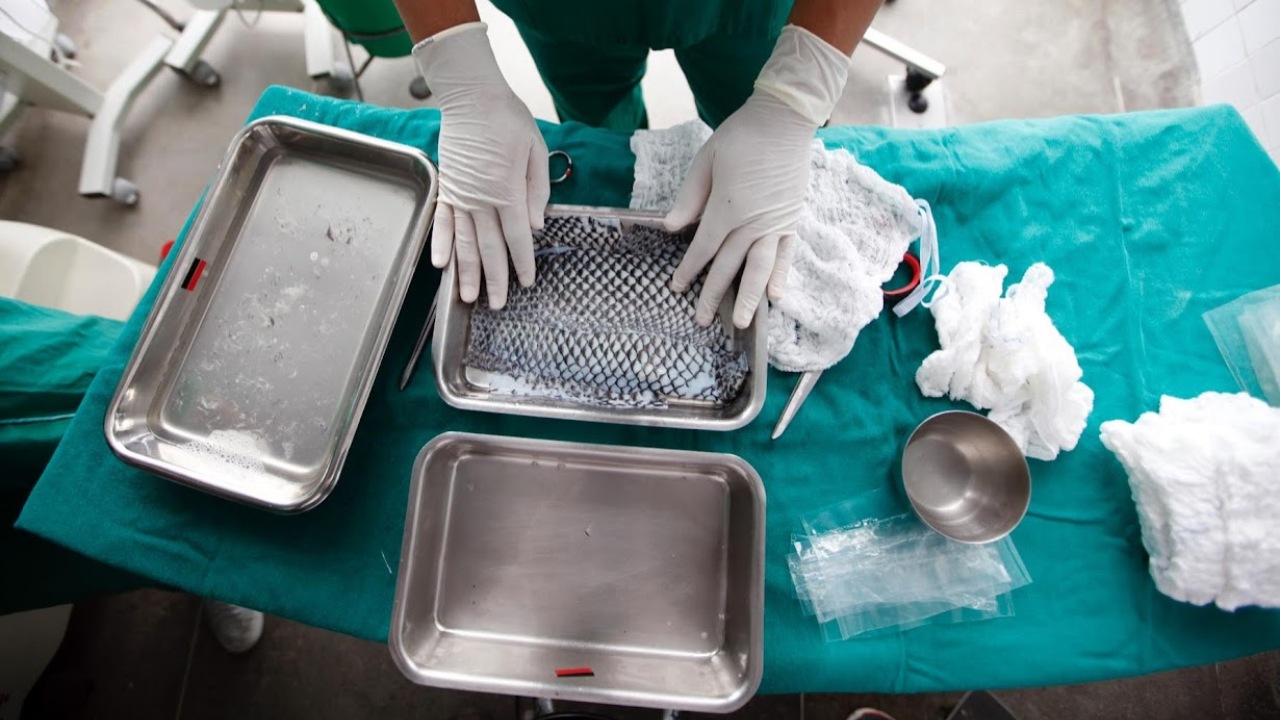
A doctor bandages a child's burn with sterilized tilapia skin: REUTERS/Paulo Whitaker
The innovation of creating a burn ointment from tilapia skin is a breakthrough made by a group of students from Yogyakarta State University (UNY) consisting of Wahyuni Eka Maryati, Priska Wahyuni, Eva Cristyani Br Tarigan, Annisa Husnul Latifah, and Rizni Rahayu. They successfully discovered that tilapia skin has unique characteristics that can be utilized in the medical world, specifically for burn treatment. Tilapia skin, often considered waste, turns out to contain biological components that are very similar to human skin, so it can be used as a natural ingredient in burn healing. This innovation not only offers an environmentally friendly solution in waste management but also provides a new alternative for safer and more effective burn treatment.
One of the main advantages of tilapia skin is its protein content which reaches 47.43 percent, as well as a water content of 23.4 percent which makes it an ideal material for maintaining wound moisture during the healing process. In addition, tilapia skin also contains type one collagen, which is the main protein found in human skin. This collagen plays an important role in tissue regeneration, aiding the wound healing process by accelerating the formation of fibrin tissue which acts as a natural bandage to close the wound. The minimal fat and ash content, 1.68 percent and 3.01 percent respectively, indicate that tilapia skin has a balanced composition, supporting the healing process without causing harmful side effects.
Tilapia skin is also known to have an SDS-PAGE pattern that shows the presence of collagen chains, although it cannot be clearly observed because it appears coincidentally. However, this pattern indicates that the collagen contained in tilapia skin has a suitable structure to support cell regeneration in burns. The use of tilapia skin as a burn medicine is not only an innovation that combines science and technology but also a strategic step in utilizing abundant resources in Indonesia.
4. Liquid organic fertilizer from tilapia offal waste
The production of liquid organic fertilizer (LOF) from tilapia waste is an innovation that stems from the need to address the problem of fish waste which is often neglected and has the potential to pollute the environment. Fish waste, especially offal, if not managed properly, can cause various environmental problems, such as water pollution due to excessive algal blooms, as well as unpleasant odors in the air. Therefore, processing fish waste into LOF is a strategic step that not only reduces the negative impact on the environment but also transforms waste into a useful resource.
Tilapia waste, especially its offal, is chosen as the base material for LOF production because it has a high nutritional content, which is very useful for plant growth. Tilapia offal contains 4.75 percent ash and 14.01 percent protein, both of which are important elements in the formation of organic fertilizers. In addition, fish offal also contains phosphorus with levels between 1-1.9 percent, which plays an important role in accelerating plant growth and strengthening the root system. With this nutritional content, LOF from tilapia waste has great potential as an effective and environmentally friendly fertilizer.
The process of making LOF from tilapia waste begins with collecting fish offal, which is usually obtained from markets or fish processing plants. The offal is then washed to remove dirt and unwanted substances before finally being ground to facilitate the fermentation process. After the offal is ground, the next step is to put it into a fermenter, which is a closed container for the fermentation process. Inside the fermenter, the fish offal is given an additional 100 ml of sugar water, one liter of water, and 150 ml of EM4, which is an organic decomposing bacteria. This fermentation process lasts for 23 days, where the microorganisms in EM4 will decompose the organic matter in the fish offal into a liquid fertilizer rich in nutrients.
The final result of this process is LOF which is rich in nutrients and very beneficial for plant growth. One plant that has been proven to benefit from this LOF is green spinach (Amaranthus viridis L). LOF from tilapia waste helps improve the quality and quantity of green spinach harvests by providing the nutrients needed by plants during their growth period.