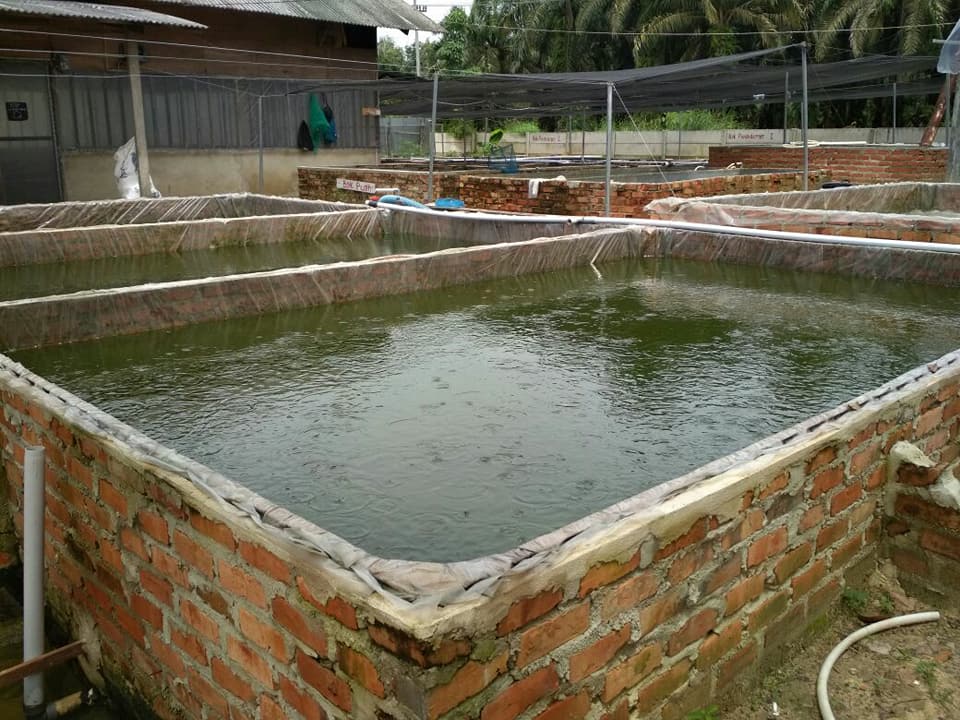

The previous article discussed cultivating Pangasius on the ground and in tarpaulin ponds. The media pond certainly has advantages and disadvantages from both a technical and non-technical point of view. In addition to using the pond media mentioned above, Pangasius ponds can also be made of concrete walls. Pangasius farming using a concrete wall pond can be used permanently and lasts for a long time. The cost of investing in a pond in this way is quite high compared to a pond made of ground or tarpaulin, so it should be done after successfully cultivating Pangasius using other ponds such as tarpaulin ponds or ground. Wall ponds can be used as long-term business investments because the durability of the pond is quite long. The procedures for cultivating Pangasius in a concrete wall pond are as follows:
1. Land preparation
Before preparing the land for the construction of a concrete wall pond, several things must be considered when choosing land for Pangasius cultivation, including:
- Choose land that is relatively flat or not steep.
- Consider choosing a large area so all cultivation activities can be carried out in the same place and close by.
- Ensure that the area is not prone to flooding and that the environment around the pond is protected from both organic and inorganic pollutants.
- Avoid choosing cultivation areas that are close to other crop fields.
- Choose a land lower than the water source to reduce the cost of filling the pond with water, as gravity can fill the water without incurring additional costs.
- Easy access to cultivation locations ensures that the fish distribution process runs effectively and efficiently.
2. Type of wall pond
Making wall ponds is adjusted to the wishes of the design, shape, and area of the pond construction. The type of ground used is clay and not porous, which is best used because it can withstand a large mass of water, making it less likely to leak and vital for holding the pond walls. It is best to have a ground slope of 3-5% to make it easier to rinse the pond with gravity. There are two wall ponds for Pangasius cultivation: excavated or planted concrete wall ponds and surface-type concrete wall ponds.
- Planting or digging a concrete wall pond
Planting or digging ponds are usually built according to the water source. This type is made using a water source from a river lower than the land surface, so excavation occurs in the dry season when the river water recedes. This is done to ensure that the minimum water limit for cultivation is met. Furthermore, during the dry season, there is no need to use a mechanical water pump to draw water.
- Surface-type concrete wall pond
This type of pond is usually built on rocky or hardened areas of land or yards, as it would be more expensive to dig the ground. The sources of water that can be used are well water, drilled wells, and dug wells. It is not recommended to use PAM water, especially in urban areas, due to its high chemical content. However, if you have to use it, you can neutralize the water to free it from water-cleaning chemicals. Due to their permanent nature, concrete wall ponds must use a steady design and calculation to ensure a match between the investment and the results to be obtained. There are several things to consider when constructing concrete pond walls.
3. The depth of the wall pond
If the harvest period is five months, the ideal depth for the Pangasius pond should be 1-1.5 m. Therefore, try to build with a depth of more than one meter. Ponds that are not deep will tend to stress the fish quickly, disrupting Pangasius's growth, especially for ponds built with a surface type. Nets or paranets are recommended to avoid jumping fish and dirty water, as tree leaves can enter the pond.
4. Pangasius fish pond area
One way for Pangasius to thrive is to have an ideal population. The ideal population for Pangasius to grow well is 25 fish per 1 m3. If you have a pond of 10 x 10 x 1 m or 100 m3, you can keep up to 2,500 fish seeds. Adding more fish than the capacity of the pond will not increase your fish yield; it can even cause losses in the form of the death of some fish or a mass die-off.
5. Water circulation
Water circulation in the cultivation of Pangasius is essential, as this fish is suitable for living in water that is clear and free of sediment. Therefore, the construction of drains must be done correctly and appropriately. We can create two drains in one pond with concrete walls.
- Channels for draining water and removing sediment.
- Channels to divert excess water in case of heavy rain.
6. Watering Pangasius pond
Irrigation of Pangasius farming ponds should be done gradually while adjusting to the development of Pangasius. The pond only needs about 30-40 cm of water to insert the tiny Pangasius seeds. After two weeks, the water level can be increased up to 10 cm until it reaches the maximum limit of between 100-150 cm. This must be done so that the Pangasius does not expend too much energy when it rises to the surface of the pond water to take in oxygen.
7. Distribution of Pangasius seeds
The distribution of Pangasius seeds begins with calculating the stocking density of seeds per square meter so that the distribution is carried out with a stocking density of 20-30 fish per square meter from the pond. The plastic seed bag container should be allowed to float on the pond's surface for about 10 minutes, then opened slowly to let the Pangasius seeds come out by themselves. This is essential to ensure that the Pangasius seeds more easily adapt to the new pond water and to prevent stress on the fish seeds.
8. Pangasius seed technique
a. Selecting prospective broodstock that is ready to spawn
Pangasius broodstock that will be spawned should be maintained in advance using intensive maintenance methods. During the maintenance, Pangasius broodstock was given feed with a high protein content and bulk twice a week, up to 10% of the brooding weight. This method is critical to speed up the gonadal maturation process. The characteristics of female broodstock that are ready to be spawned include:
- Three years old.
- Size between 1.5 and 2 kg.
- The stomach appears to be enlarged in comparison to the anus.
- When held, the stomach will feel smooth and soft.
- The cloaca is swollen and dark red.
- The skin in the abdominal area feels soft and delicate.
When the cloaca is pressed, the eggs are round and uniform in size. The main characteristics of male Pangasius broodstock that are ready to be spawned are as follows:
- Two years old.
- Size between 1.5 and 2 kg.
- The skin in the abdominal area feels soft and delicate.
- White discharge is emitted when massaged.
- The genital area swells and is slightly dark red.
b. Stimulating hormone preparation
The stimulating hormone for Pangasius uses the carp's pituitary gland, which is usually found in the carp's brain and is relatively small and white. Carefully take the pituitary using tweezers and immediately insert it into a small tube, then puree until it is soft and smooth. Afterward, mix the goldfish brain with pure or distilled water, which can be purchased at a pharmacy.
c. Injectable spawning
After the pituitary gland has been mixed with pure water and is ready, take a syringe and insert the liquid. Inject it into the back of the Pangasius that are ready to be spawned. This method of injecting or inducing breeding stimulates the female Pangasius broodstock so they can later release eggs, which will be fertilized by the male Pangasius. After fertilizing the eggs, they will hatch about four days later. While waiting for the eggs to hatch, the water conditions must be monitored and replaced with clean, well water.
9. Keeping Pangasius
a. Caring for Pangasius larvae
One-year-old Pangasius seeds will later be transferred to a tub or aquarium with dimensions of 80 cm x 45 cm x 45 cm, although other sizes can also be used. Each tank or aquarium will be filled with well-aerated water, with a stocking density of 500 fish per aquarium or tank. Aerators will be placed in each aquarium to meet the oxygen needs of the Pangasius seeds. To maintain temperature properly, a heater can be used to save costs instead of using a stove. Seeds one day old do not need additional feed, as they still have food reserves in the form of yellow or yolk sacs. After three days, however, the Pangasius seeds will need extra feed in the form of boiled chicken egg yolk emulsion. They can be given live food as they age, such as mosquito larvae and water fleas.
b. Pangasius feeding
Pangasius weighing less than 200 grams per head can be fed up to 3-5% of their total body weight twice daily, in the morning and the evening. Once the fish's weight has increased to more than 200 grams per head, they can be fed 1.5-2% of their total weight once a day, in the afternoon. In addition to the main feed in the form of pellets, Pangasius can also be given other natural food such as gold snails, leftover fish, biscuits, bread waste, snails, and kitchen waste or other waste to save on maintenance costs in the fourth month.
10. Pest and disease management
One of the severe problems that occur in Pangasius farming is pest and disease attacks. Generally, pests attacking Pangasius farming include water snakes, birds, linsangs, monitor lizards, and turtles. Disease attacks can take the form of infectious diseases and non-communicable diseases.
11. Harvest pangasius
Harvesting pangasius can be done in two ways: total and partial. Partial harvesting is a partial harvest by reducing pond water, then some fish are gathered based on the desired size, and some are left to be reared again. In contrast, total harvesting takes all the fish in the cultivation pond without leaving any fish.