
Pangasius fish farming in Indonesia has experienced significant growth in recent years. Many fish farmers are interested and directly involved in this aquaculture activity, making it a promising sector in the fishery industry. Among the various pangasius species cultivated, Pangasius hypophthalmus, also known as patin fish, has become the most popular and widely cultivated. The advantages of this species in terms of rapid growth and good adaptation to various environmental conditions make it a top choice in both domestic and international markets.
In addition to Pangasius hypophthalmus, another species that has been successfully cultivated is Pangasius djambal. This species has undergone a careful domestication process, allowing farmers to optimize its production. The successful domestication of Pangasius djambal demonstrates the great potential of other pangasius species that may not be widely known.
However, besides these two species, there is another type of pangasius fish that has quite promising development potential, namely Pangasius nasutus. Although not yet widely known and cultivated, Pangasius nasutus exhibits unique characteristics that could make it an attractive alternative for the development of fish farming in Indonesia. This article will provide a comprehensive review of Pangasius nasutus, including its taxonomy and morphology, geographical distribution, feeding habits, and embryonic and larval development processes.
Taxonomy and morphology of Pangasius nasutus
Pangasius nasutus is a fish species from the Pangasiidae family that has the potential to be developed in aquaculture. To understand more about this species, let's look at the taxonomy and morphology of Pangasius nasutus.
Taxonomy of Pangasius nasutus
- Kingdom: Animalia
- Phylum: Chordata
- Class: Actinopterygii
- Order: Siluriformes
- Family: Pangasiidae
- Genus: Pangasius
- Species: Pangasius nasutus
Unique and distinguishing physical characteristics
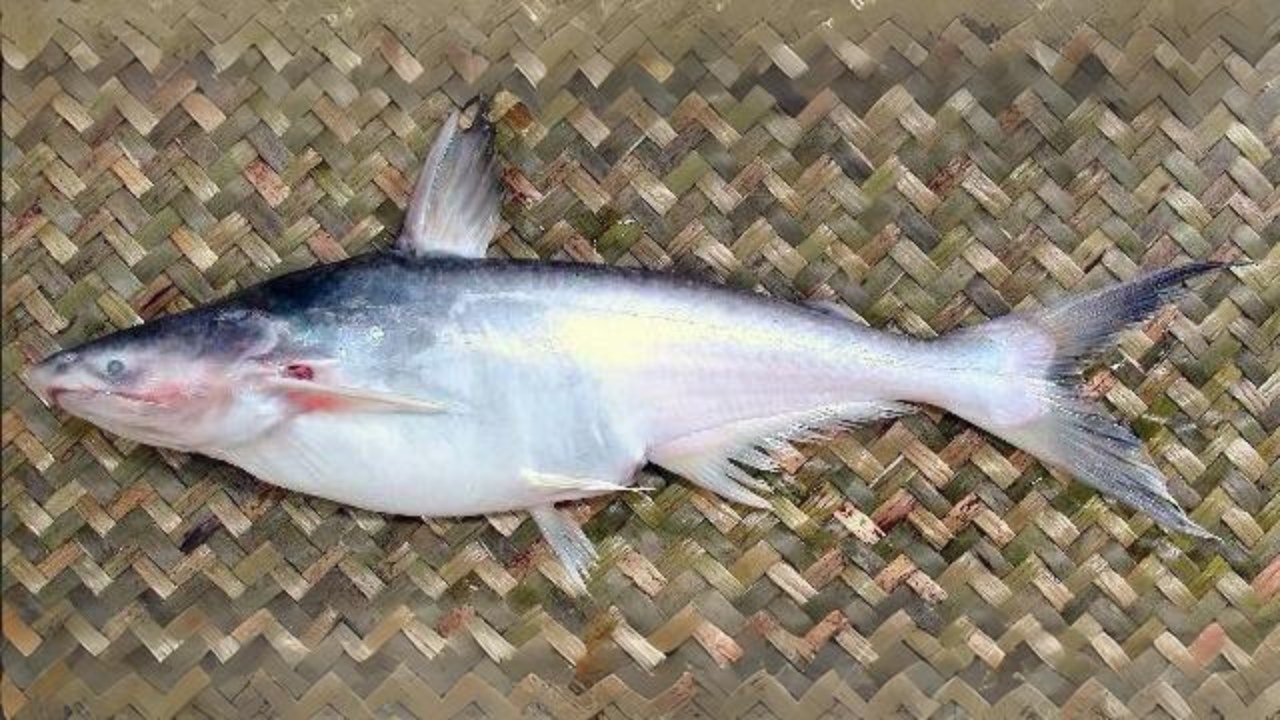
The morphology of Pangasius nasutus has distinctive features that differentiate it from other species in the pangasius genus. One of the striking main features is the position of its mouth, which is located at the bottom (inferior). This position is a special adaptation that makes it easier for this fish to forage at the bottom of the water. In addition, the long and very prominent or pointed snout of Pangasius nasutus adds a unique impression to its appearance. This prominent snout not only functions for foraging but also plays a role in social interactions between fish.

Pangasius nasutus: Lord Mountbatten
When the mouth of Pangasius nasutus is closed, the entire arrangement of teeth on its upper jaw is clearly visible, giving it a rather impressive appearance. These teeth are very sharp, indicating that this fish has the ability to cut or tear hard food, such as seeds or even other small fish. The sharpness of these teeth is also one of the important adaptation factors for Pangasius nasutus in defending itself from predators in its natural habitat.
The eye size of Pangasius nasutus is relatively small, with a diameter ranging from 6.6 percent to 13 percent of its head length. This small eye size indicates that this fish may rely more on other senses, such as smell or touch, in foraging or detecting its surroundings. This adaptation may be related to its feeding habits at the bottom of waters that tend to be dark or murky, where vision is not the primary sense used.
Body proportions and dorsal structure
In terms of body proportions, Pangasius nasutus has a slender tail stalk height, ranging from 5.8 percent to 8 percent of its standard body length. This indicates that this fish may have fast and agile swimming abilities, allowing them to move nimbly in dense or fast-flowing waters. The body width of Pangasius nasutus ranges from 16.9 percent to 21.7 percent of its standard body length, giving it an elongated and aerodynamic body shape, ideal for adapting to the water conditions where they live.
The gill structure of Pangasius nasutus also has its own distinctive features. The gill rakers on the first gill arch number less than 27, with a range of 16 to 24 rakers. This structure functions to filter small food particles from the water, making it easier for this fish to eat plankton, benthos, or other organic particles. In addition, Pangasius nasutus is equipped with two dorsal spines, which provide extra protection from predators, as well as seven soft rays on the dorsal fin and 26 to 30 soft rays on the anal fin, which play a role in helping stability and maneuverability while swimming.
Distribution and feeding habits
Pangasius nasutus is a fish species that has a fairly wide geographical distribution in Indonesia. This fish can be found in various large bodies of water, especially in rivers that have strong currents and rich ecosystems. The Kapuas River in Kalimantan, which is the longest river in Indonesia, is one of the main habitats for Pangasius nasutus. In addition, this species is also found in the Barito and Kahayan Rivers that flow in the Central Kalimantan region, as well as the Batang Hari River that crosses the West Sumatra and Jambi regions. The Batang Rajang River in West Kalimantan, the Indragiri River in Riau, and the Musi River in South Sumatra are also part of the natural habitat of Pangasius nasutus.

Pacu Jalur Competition on the Indragiri River, a Natural Habitat for Pangasius Nasutus
The presence of Pangasius nasutus in these various large rivers demonstrates its high adaptability to various environmental conditions. These rivers not only have different physical characteristics, such as current velocity and depth, but also have variations in terms of water quality and substrate types. Pangasius nasutus can adapt to these diverse conditions, making it one of the fish species that is resistant to the environmental changes that often occur in natural waters.
One of the main factors supporting the successful adaptation of Pangasius nasutus in various habitats is its broad feeding ability. As an omnivorous fish, Pangasius nasutus has a very flexible feeding pattern. This fish utilizes various types of food available in its environment, including benthos, seeds, aquatic plants, and other small fish. Benthos, which are small organisms that live at the bottom of waters such as worms, insect larvae, and crustaceans, are one of the main food sources for Pangasius nasutus. The ability of this fish to find and consume benthos shows that Pangasius nasutus can live in waters that have a muddy or sandy bottom, where benthos is usually found in abundance.
In addition, Pangasius nasutus also consumes seeds and aquatic plants, which are often found along the banks of rivers and lakes. Aquatic plants such as algae and leaves that fall into the water become an important part of its diet, especially in certain seasons when the availability of other food may be limited. This adaptation allows Pangasius nasutus to survive despite seasonal changes in food availability in their environment.
Last but not least, Pangasius nasutus also preys on other small fish, which provides the necessary protein intake for growth and reproduction. The ability to prey on other fish shows that Pangasius nasutus has good predatory instincts, as well as the ability to adjust its feeding patterns depending on the availability of prey. This broad feeding adaptation allows Pangasius nasutus to adapt quickly to environmental changes and ensure its survival in various water conditions.
Embryonic and larval development
The embryonic and larval development of Pangasius nasutus follows a general pattern similar to other species in the Pangasiidae family and the whiskered fish group of the Siluriformes order. However, despite the basic similarities in this development process, Pangasius nasutus also shows some important differences that make it unique and can be used as an identification key.
In the early stages, the fertilization process occurs externally, where sperm and eggs meet outside the female parent's body. After fertilization, these eggs begin to undergo rapid cell division, forming a blastula and then a gastrula. This stage takes place in an aquatic environment whose quality must be maintained to support optimal development. One aspect of concern is the diameter of Pangasius nasutus oocytes and eggs, which differs from other Pangasiidae species. This difference indicates that Pangasius nasutus has specific reproductive characteristics, which may be influenced by genetic and environmental factors.
After incubation, the eggs will hatch into larvae. The size of the newly hatched larvae is one of the important characteristics that can be used to distinguish Pangasius nasutus from other species. Pangasius nasutus larvae usually have a slightly larger or smaller size compared to larvae of other species in the same family. This size not only reflects the condition of the embryo during incubation but also the growth potential of the larvae in the future.
Pigmentation or coloration in Pangasius nasutus larvae also has unique characteristics. The body color of the larvae, especially in the early stages of development, can provide clues about the health and environmental conditions where the larvae develop. This pigmentation usually develops over time, with increasingly clear color patterns as the larvae begin to grow and develop. The distinctive pigmentation in Pangasius nasutus larvae can also be used as an identification criterion in scientific research and aquaculture management.
The incubation period for Pangasius nasutus eggs varies depending on water temperature, water quality, and other environmental factors. This period is very important because it determines the right time for hatching and handling the larvae. Under optimal conditions, these eggs will hatch in a relatively short time, and the resulting larvae will be ready for the next stage in their life cycle.