
Jerbung shrimp (Penaeus merguiensis) is a tropical organism that inhabits turbid waters rich in organic matter with muddy sandy bottom (Carpenter & Niem, 1998). Jerbung shrimp in their life cycle use mangrove forest estuaries as nursery areas and offshore seas as spawning areas (Subrahmanyam, 1971; Gilanders, 2003). Migration and their abundance are related to rainy season conditions (Haywood & Staples, 1993; Evans & Opnai, 1995; Sheavesetal., 2012). Jerbung shrimp has the following classification:
Phylum : Arthropoda
Subphylum : Crustacea
Class : Malacostraca
Order : Decapoda
Family : Penaeidae
Genus : Penaeus
Type : Penaeus merguiensis
Morphology
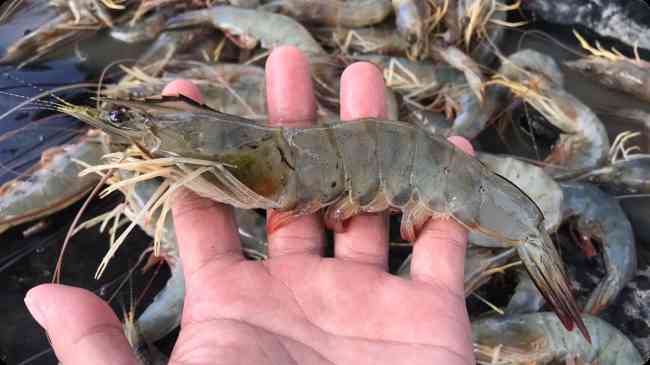
The body shape of the jerbung shrimp is the same as other shrimp. It's just that the body’s color is slightly different, namely yellowish white and the pattern of spots on the body. The spots are green and yellow, with the legs and tip of the tail red. The upper rostrum teeth are 5-8 pieces, while the bottom teeth are 2-5 pieces. Below the base of the rostrum are movable stalked compound eyes.
The jerbung shrimp pereopods consist of five pairs, three pairs of which have claws, two pairs of which do not have claws. On the abdomen, there are five pairs of swimming legs (period). These swimming legs are located in each segment. In the sixth segment, there is a swimming leg that has changed shape into a fantail, with the tip that looks like a tail (telson).
The carapace length of male jerbung shrimp (Penaeus merguiensis) ranged from 20-62 mm while the female jerbung shrimp ranged from 14-68 mm. Most of the carapace length of jerbung shrimp is around 28 mm (Ernawati, 2016).
Habitat
The original habitat of the jerbung shrimp is spread throughout Indonesian waters from Aceh to Irian and is a shrimp caught in large enough groups. This shrimp is benthic; lives on the ocean floor. This shrimp usually lives about 60-80 miles from the shore, to be precise at a depth of 8-80 mbsl (meter below sea level).
Reproduction
Jerbung shrimp breed in two waters, namely seawater and brackish waters. Where spawning occurs in seawater. Jerbung shrimp are heterosexual (different sexuality), so male and female sex can be distinguished through their reproductive organs. The male reproductive organs consist of testes, vasa differentiation, petasma, and masculine appendix. The petasma part is at the swimming legs and the genital opening is between the fourth and fifth walking legs. While the female reproductive organs consist of a pair of ovaries and oviducts, genital openings, and thelycum (located between the fourth and fifth walking legs).
Jerbung Shrimp Prospect

Source: kkp.go.id
jerbung shrimp is a type of shrimp native to Indonesia and has great potential to become a new mainstay commodity for national exports in the future. This is evidenced by the success of BBPBAP Jepara ( Brackish Water Cultivation Fisheries Center) which is able to produce 20 million jerbung shrimp seeds. As many as 12 million seeds of which are artificial brooders that do not come from catches in nature. It is hoped that in 2020 the jerbung cultivation business can be implemented in the community. Head of BBPBAP Jepara Sugeng Rahardo said:
"We are targeting that in 2020 the cultivation of jerbung shrimp is really applicable to the community. Then, as with the function of the hall, after seeding, we will then do stock restocking in nature,".
BBPBAP Jepara has been producing jerbung shrimp fry for the past few years because the Indonesian government wants to reduce its dependence on vannamei shrimp (Litopenaeus vannamei) which has been the prima donna of export commodities for a long time. To break this dependence, the government decided to develop jerbung shrimp whose seeds can be found in Indonesian waters. The shrimp is a jerbung shrimp found in the waters of the Arafura Sea, Maluku, which is known to be more resistant to disease (M. Ambari, 2019).
References
Carpenter, K.E. & Niem, V.H. (1998). The living marine resources of the Western Central Pacific.Vol. 2. Cephalopods, crustaceans, holothurians, and sharks (p.1367). FAO Species Identification Guide for Fishery Purposes. Rome.
Ernawati, T. d., 2016. Kajian biologi udang jerbung (Penaeus merguiensis De Man, 1888) di Perairan Utara Jawa Tengah. bawal widya riset perikanan tangkap (bawal), VIII(2), pp. 109-116.
Haywood, M.D.E. & Staples, D.J. (1993). Field estimates of growth and mortality of juvenile banana (Penaeus merguiensis). Marine Biology. 116, 407- 416.
M Ambari, 2019. Inilah udang jerbung, masa depan bisnis udang nasional. [Online]
Available at: https://www.mongabay.co.id/2019/09/19/inilah-udang-jerbung-masa-depan-bisnis-udang-nasional/
[Diakses 11 Januari 2021].
Subrahmanyam, C.B. (1971). The relative abundance and distribution of penaeid shrimp larvae off the Mississippi Coast. Gulf research reports. 3(2). DOI: 10.18785/grr.0302.10 Follow this and additional works at: http://aquila.usm.edu/gcr